
Oral Surgery
Oral and maxillofacial surgery at Thrive Dental with Dr. Roger K. Lau, DDS, including wisdom teeth removal, dental implant surgery, and bone grafting.
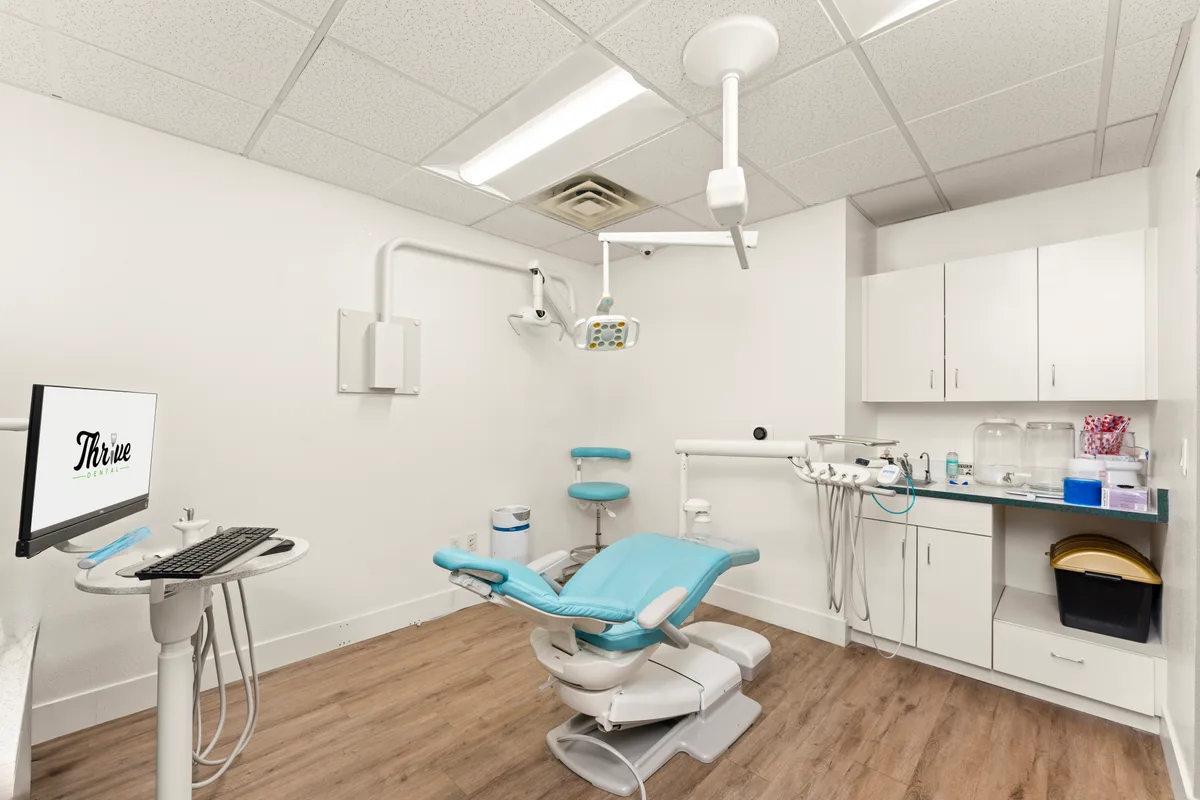
Oral and Maxillofacial Surgery at Thrive Dental
Some dental problems reach past what routine treatment can correct. An impacted wisdom tooth pressing into the molar beside it, a jaw that has lost bone volume after years without a tooth, a fractured tooth below the gum line, a jaw that does not close correctly. These situations call for surgical training, careful planning, and a treatment setting where the surgery and the restorative work are handled by the same team.
Thrive Dental now provides oral and maxillofacial surgery in house. That means patients across our five Northern California offices can move from diagnosis to surgery to final restoration without being handed off to an unfamiliar practice, and without repeating imaging, paperwork, and treatment planning at every step.
Your Oral and Maxillofacial Surgeon
Oral and maxillofacial surgery is one of the twelve dental specialties recognized by the National Commission on Recognition of Dental Specialties and Certifying Boards. It requires a dental degree followed by a hospital-based surgical residency lasting four or more years.
Dr. Roger K. Lau, DDS earned his DDS at the UCLA School of Dentistry, completed dual oral and maxillofacial surgery internships at Montefiore Medical Center and Mount Sinai Hospital in New York City, and completed a four-year residency at Allegheny Health Network in Pittsburgh that included a chief resident year. His surgical training covers dental implants, sleep apnea surgery, corrective jaw procedures, and facial trauma. He is a member of the American Association of Oral and Maxillofacial Surgeons (AAOMS) and the American College of Oral and Maxillofacial Surgeons (ACOMS).
Every other doctor at Thrive Dental is a general dentist. When your treatment plan calls for surgery, Dr. Lau handles that portion of your care.
Procedures We Perform
Wisdom Teeth Removal
Third molars are the last teeth to develop, and most jaws do not have room for them. When they cannot erupt into a functional position, they become impacted, which can cause pain, repeated infection of the surrounding gum tissue, decay in the adjacent molar, cyst formation, and damage to nearby roots.
We evaluate wisdom teeth with digital imaging, assess the position of each tooth and its relationship to the nerve and sinus, and recommend removal only when the findings justify it. Removal is often easier in the late teens and early twenties, when roots are still forming and the surrounding bone is less dense.
Surgical Tooth Extraction
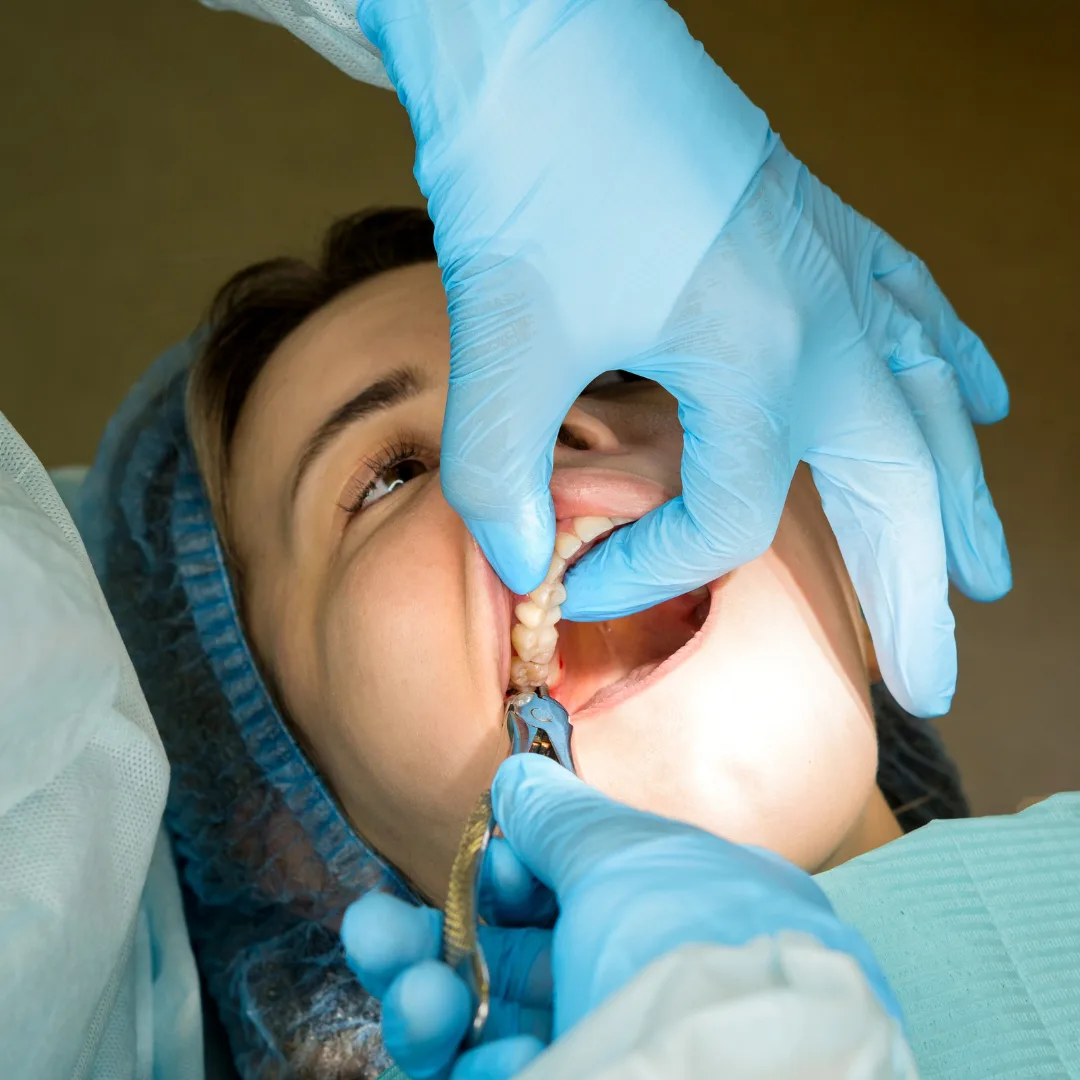
Not every tooth can be removed simply. Teeth that are fractured below the gum line, badly decayed, ankylosed, or curved at the root require a surgical approach: a small incision, careful sectioning of the tooth, and closure with sutures. This preserves the surrounding bone for a future restoration and reduces the chance of complications. See our tooth extraction page for what to expect from a routine extraction.
Dental Implant Surgery
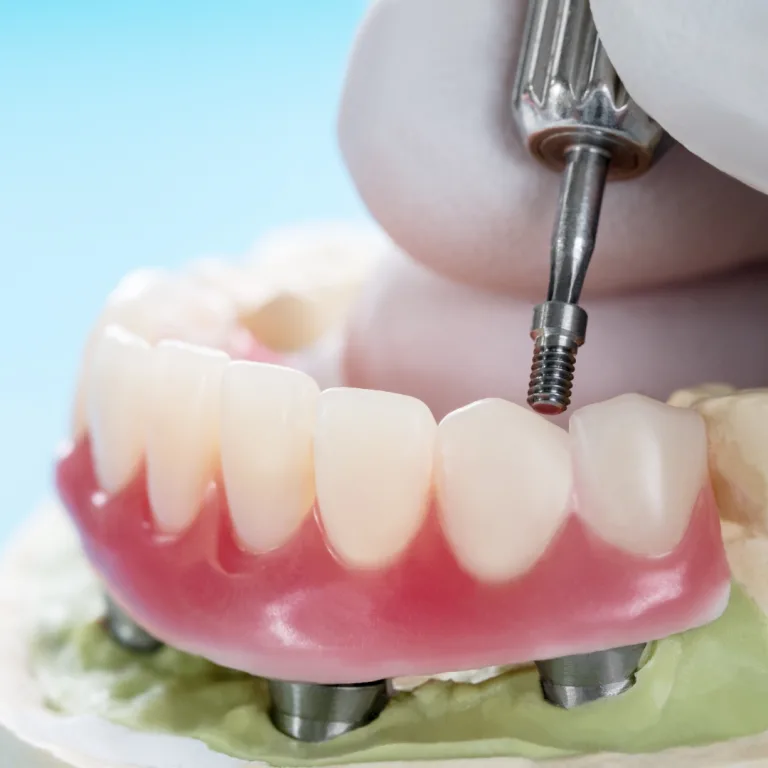
A dental implant is a titanium post placed into the jawbone that acts as an artificial tooth root. Surgical placement determines whether the implant integrates properly, how the final crown looks, and how long the restoration lasts. Position, angulation, depth, and available bone volume all matter.
Having the surgical placement and the restorative work coordinated inside one practice removes a common failure point. The surgeon places the implant with the final restoration already planned, and your restorative dentist completes it. This applies to single implants, multiple implants, and full-arch implant solutions including All-on-4.
Bone Grafting and Sinus Lifts
Jawbone begins to resorb as soon as a tooth is lost. Patients who have been missing teeth for years often do not have the bone volume needed to support an implant. A bone graft rebuilds that foundation.
A sinus lift is a specific graft used in the upper back jaw, where the maxillary sinus sits close to the ridge and limits vertical bone height. Ridge preservation is a smaller graft placed at the time of extraction to limit collapse of the socket before an implant is planned. Both are routine parts of implant planning rather than separate ordeals.
Impacted and Exposed Teeth
Canines and other teeth sometimes fail to erupt on their own. Working alongside orthodontic treatment, an exposure procedure uncovers the impacted tooth and allows a bracket and chain to be attached so it can be guided into position rather than removed.
Pre-Prosthetic Surgery
Before dentures or full-arch restorations can fit comfortably and function well, the underlying ridge sometimes needs to be reshaped. This includes smoothing bony irregularities, reducing excess soft tissue, and removing retained roots. Small corrections at this stage make a substantial difference in how a denture seats and performs.
Biopsy and Oral Pathology
Persistent sores, unexplained lumps, discolored patches, and lesions that do not heal within two weeks should be evaluated. When a lesion warrants further investigation, a biopsy provides a definitive diagnosis. This works hand in hand with routine oral cancer screening, which every Thrive Dental patient receives as part of a comprehensive exam. Early detection meaningfully changes outcomes for oral cancer.
Corrective Jaw Surgery and Facial Trauma
Orthognathic surgery repositions the upper jaw, lower jaw, or both to correct skeletal discrepancies that cause difficulty chewing, speech problems, chronic jaw pain, or airway obstruction. Facial trauma care addresses fractures and injuries to the jaws and surrounding structures, including revision of previously treated injuries.
These are complex cases. They begin with a consultation and a full workup at Thrive Dental, and the surgical phase is performed in the appropriate clinical setting for the procedure, coordinated with your orthodontist and physicians where relevant.
Surgical Management of Obstructive Sleep Apnea
Most patients with mild to moderate obstructive sleep apnea do well with a custom oral appliance or CPAP. For patients who cannot tolerate those options, or whose anatomy limits their effectiveness, surgical airway procedures are an alternative worth evaluating. Dr. Lau’s residency training included sleep apnea surgery, so patients who have exhausted conservative options can be assessed here instead of starting a new referral chain elsewhere.
Anesthesia and Comfort
Anesthesia is not one setting. It ranges from local anesthetic that numbs a specific area to deeper levels of sedation, and the right choice depends on the procedure, your medical history, your anxiety level, and your preference.
Your surgeon reviews the appropriate options for your specific case at the consultation, along with the preparation required, whether you will need someone to drive you home, and what recovery looks like. Patients who have avoided treatment because of dental anxiety should raise it at that appointment. It changes the plan.
What to Expect
Consultation and Planning
Your first visit is an evaluation, not a procedure. We review your medical history and current medications, examine the area, take digital imaging, and discuss what we find. You leave with a written treatment plan, an anesthesia recommendation, a cost estimate reviewed against your benefits, and a clear description of the recovery period.
The Day of Surgery
You receive written preparation instructions in advance covering eating and drinking, medications, and transportation. On the day itself, the plan is reviewed with you again before anything begins. Most office-based oral surgery procedures take between thirty and ninety minutes.
Recovery and Follow-Up
You go home with written aftercare instructions, prescriptions if they are indicated, and a direct line to reach us. Swelling typically peaks around forty-eight hours and improves from there. Most patients return to routine activity within two to three days after a surgical extraction, while implant and grafting cases involve a longer biological healing period before the final restoration is placed. We schedule a follow-up appropriate to your procedure and monitor healing until it is complete.
Why Surgical Care Inside Your Dental Home Matters
The usual path looks like this: your dentist identifies a problem, refers you out, you wait for an appointment at an unfamiliar office, you repeat your history and your imaging, the surgery happens, and then you return to your dentist to finish the restorative work. Information gets lost in the gaps, and the treatment plan is negotiated across two practices that do not share records.
When surgical and restorative care sit inside one practice, the plan is built once. Your surgeon and your general dentist look at the same imaging, agree on the sequence before anything starts, and finish the case together. That coordination is the practical reason a general practice adds an oral and maxillofacial surgeon.
Oral Surgery Across Northern California
Oral surgery consultations are coordinated across all five Thrive Dental offices:
- Oral surgery in Dixon at 255 N Lincoln St Suite B, serving Solano County, Vacaville, Fairfield, Davis, Winters, and Woodland
- Oral surgery in Elk Grove at 9307 Laguna Springs Dr #110, serving the greater Sacramento area, Laguna, Franklin, Vineyard, Sheldon, and Wilton
- Oral surgery in Yuba City at 1170 Live Oak Blvd, serving Sutter and Yuba counties, Marysville, Live Oak, Gridley, and Plumas Lake
- Oral surgery in Stockton at 3031 W March Ln #328, serving San Joaquin County, Lodi, Manteca, Tracy, Lathrop, and Ripon
- Oral surgery in Santa Clara at 545 Saratoga Ave B, serving Silicon Valley, Sunnyvale, Cupertino, Mountain View, Campbell, and Milpitas
Surgical scheduling varies by office and by procedure. Call the location nearest you or book online and our team will place you on the appropriate surgical schedule.
Cost, Insurance, and Financing
Oral surgery fees vary with the complexity of the procedure, the anesthesia used, and whether grafting is involved. We provide a written estimate before you commit to treatment.
Coverage splits between dental and medical benefits depending on the diagnosis. Surgical extractions and impacted wisdom teeth are commonly covered under dental plans. Procedures with a medical basis, including jaw reconstruction, pathology, and treatment related to obstructive sleep apnea, are sometimes billed to medical insurance. Our administrative team verifies both before treatment.
For balances not covered by insurance, we offer third-party financing options with monthly payment plans, including applications that do not affect your credit score to check.
Schedule an Oral Surgery Consultation
If you have been told you need wisdom teeth removed, you are missing teeth and want to know whether implants are an option, you have a tooth that cannot be saved, or you have a persistent sore or lump that has not healed, the next step is an evaluation.
Book a consultation at any of our five Northern California locations, or learn more about Dr. Lau.
Frequently Asked Questions
Oral and maxillofacial surgery is one of the twelve dental specialties recognized by the National Commission on Recognition of Dental Specialties and Certifying Boards. After earning a dental degree, an oral and maxillofacial surgeon completes an additional multi-year hospital-based surgical residency covering anesthesia, surgical extraction, dental implant placement, jaw reconstruction, and the management of facial injuries and pathology. Dr. Roger K. Lau completed a four-year residency at Allegheny Health Network in Pittsburgh, including a chief resident year.
No referral is required. You can book an oral surgery consultation directly. If you are already a Thrive Dental patient, your general dentist can coordinate the referral internally so your records, imaging, and treatment plan move with you instead of starting over at an outside office.
Wisdom teeth are usually evaluated in the late teens and early twenties, when the roots are still forming and recovery tends to be faster. Removal is generally recommended when the teeth are impacted, when there is not enough room for them to erupt in a functional position, when they are causing crowding or damage to the neighboring molar, or when repeated infection, decay, or cyst formation is present. Not every wisdom tooth needs to come out. We recommend removal only when the clinical findings support it.
Anesthesia is selected case by case based on the procedure, your medical history, and your preference. Options range from local anesthetic for straightforward procedures to deeper levels of sedation for more involved surgery. Your surgeon reviews the options with you at your consultation, along with the preparation instructions and the recovery timeline associated with each.
Most patients return to normal daily activity within two to three days after a routine surgical extraction, with swelling peaking around day two and improving from there. Complete soft tissue healing usually takes one to two weeks. Bone grafting and implant surgery involve a longer biological healing period, often three to six months before the final restoration is placed. We give you written aftercare instructions and a follow-up schedule specific to your procedure.
It depends on the procedure and the reason for it. Surgical extractions and impacted wisdom teeth are frequently covered under dental benefits. Procedures tied to a medical diagnosis, such as jaw reconstruction, pathology, or treatment related to obstructive sleep apnea, are sometimes billed to medical insurance instead. Our team reviews your benefits before treatment and gives you a written estimate so there are no surprises. We also offer third-party financing options through our [financing partners](/financing/).
In many cases yes. Placing an implant into the socket at the time of extraction, sometimes called immediate placement, can shorten the overall treatment timeline and help preserve the surrounding bone. Whether it is appropriate for you depends on the amount of remaining bone, the presence of infection, and the condition of the surrounding gum tissue. Your surgeon evaluates this during the planning appointment.
When a tooth is missing for an extended period, the jawbone that once supported it begins to shrink. A bone graft rebuilds that lost volume so there is enough healthy bone to anchor a dental implant. Grafting is also used to repair defects after cyst removal or trauma, and a sinus lift is a specific type of graft used in the upper back jaw where the sinus floor limits available bone height.
Oral surgery consultations and treatment are coordinated across all five Thrive Dental offices in Dixon, Elk Grove, Yuba City, Stockton, and Santa Clara. Surgical scheduling varies by office and by procedure, so call the location nearest you or book online and our team will place you on the appropriate surgical schedule.
Related Services
Dental Implants
Straumann dental implants offer permanent tooth replacement with high clinical success rates--the closest restoration to natural teeth.
Tooth Extractions
Tooth extraction at Thrive Dental is performed only when a tooth cannot be saved, with full emphasis on comfort and aftercare.
Sleep Apnea Treatment
Dental sleep apnea appliances as an effective alternative to CPAP machines at Thrive Dental.
Get Oral Surgery Near You
Ready for Oral Surgery?
Schedule your appointment at any of our five Northern California locations. Our team is here to help you achieve the smile you deserve.